

Clock Buffer Market In 2029
Clock Buffer Global Market Report 2025_Segments.webp
Clock Buffer Global Market Report 2025_Drivers.webp
Clock Buffer Global Market Report 2025_Regions.webp
The Business Research Company's Clock Buffer Global Market Report 2025 – Market Size, Trends, And Global Forecast 2025-2034
LONDON, GREATER LONDON, UNITED KINGDOM, December 31, 2025 /EINPresswire.com/ -- "Clock Buffer Market to Surpass $4 billion in 2029. In comparison, the Other Electrical Equipment, Electronic Products And Components market, which is considered as its parent market, is expected to be approximately <2029 parent market size> by 2029, with Clock Buffer to represent around <% share of market within parent market>% of the parent market. Within the broader Electrical And Electronics industry, which is expected to be $5,240 billion by 2029, the Clock Buffer market is estimated to account for nearly 0.1% of the total market value.
Which Will Be the Biggest Region in the clock buffer Market in 2029
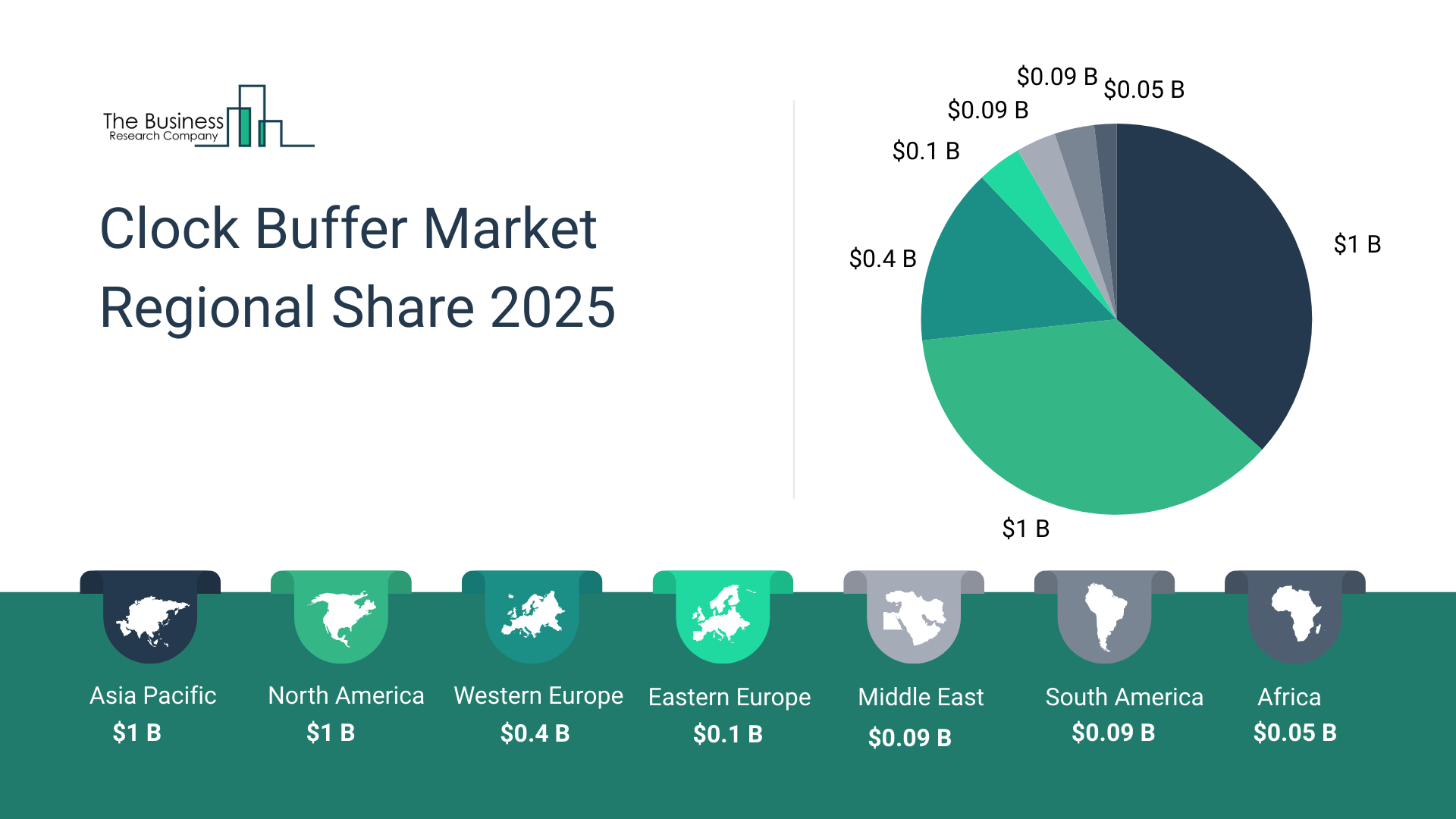
Asia Pacific will be the largest region in the clock buffer market in 2029, valued at $1,435 million. The market is expected to grow from $891 million in 2024 at a compound annual growth rate (CAGR) of 10%. The strong growth can be attributed to the rising demand for energy efficiency solutions and increasing internet of things (IoT) device connectivity.
Which Will Be The Largest Country In The Global Clock Buffer Market In 2029?
The USA will be the largest country in the clock buffer market in 2029, valued at $886 million The market is expected to grow from $644 million in 2024 at a compound annual growth rate (CAGR) of 7%. The strong growth can be attributed to the rising demand for energy efficiency solutions and expansion of cloud computing.
Request a free sample of the Clock Buffer Market report
https://www.thebusinessresearchcompany.com/sample_request?id=8762&type=smp
What will be Largest Segment in the Clock Buffer Market in 2029?
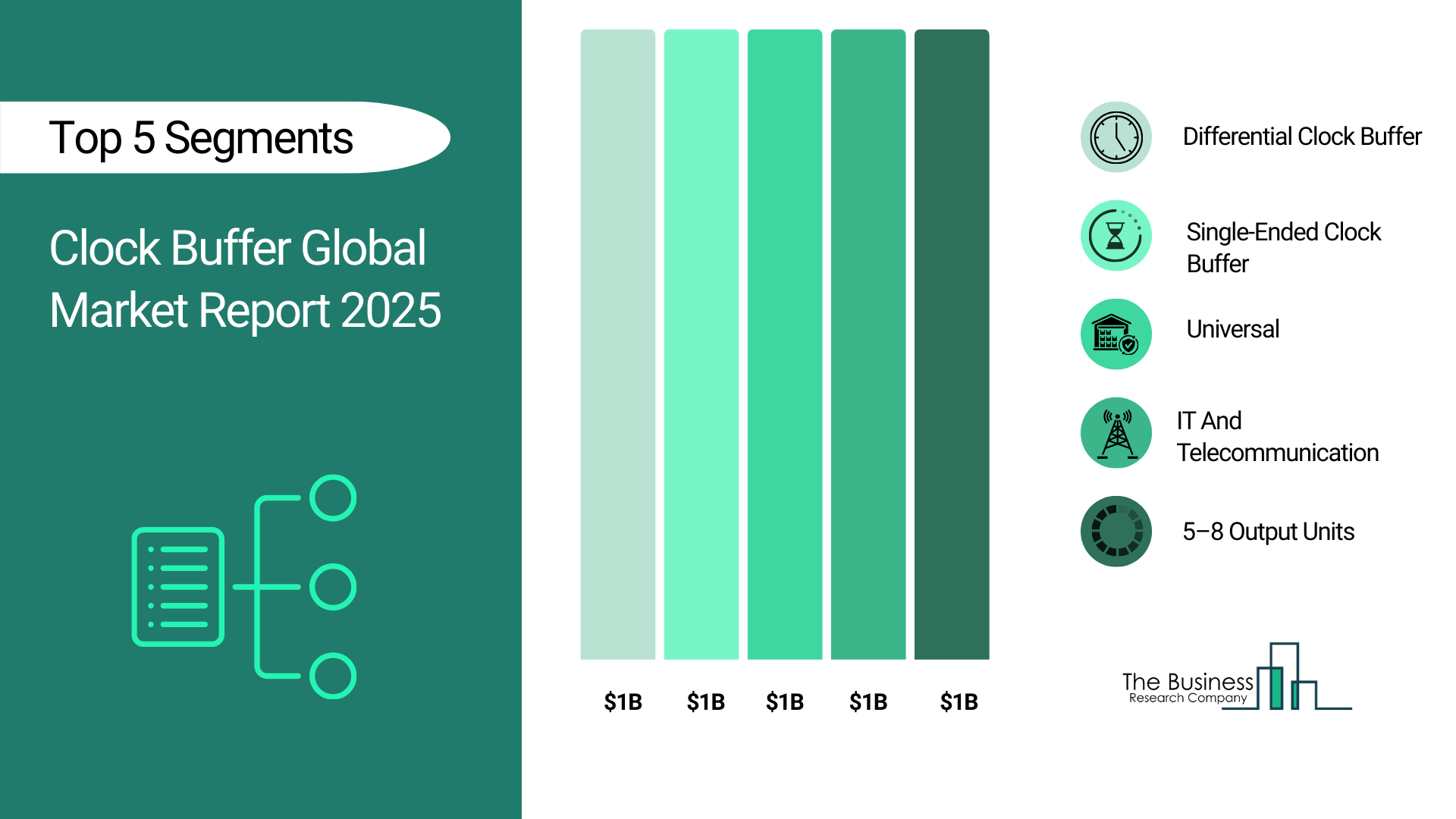
The clock buffer market is segmented by type into differential clock buffer, single-ended clock buffer, universal and other types. The differential clock buffer market will be the largest segment of the clock buffer market segmented by type, accounting for 43% or $1,703 million of the total in 2029. The differential clock buffer market will be supported by increased adoption in high-speed and high-frequency data communication systems, improved signal integrity and noise immunity over single-ended solutions, growing use in data centers and high-performance computing, demand for low-jitter timing in telecommunications equipment, advancements in precision timing for AI and machine learning systems, integration into next-generation automotive electronics and widespread usage in RF and microwave applications.
The clock buffer market is segmented by application into military and defense, industrial, consumer electronics, information technology (IT) and telecommunication, automotive, mobile devices, server and other applications. The information technology (IT) and telecommunication market will be the largest segment of the clock buffer market segmented by application, accounting for 27% or $1,073 million of the total in 2029. The information technology (IT) and telecommunication market will be supported by rapid deployment of 5G infrastructure, increasing demand for high-speed data transmission, critical timing synchronization needs in telecom base stations, growth in fiber-optic networks and switching systems, integration in network interface cards and routers, rising cloud computing workloads and expanding global internet connectivity and mobile penetration.
The clock buffer market is segmented by number of output units into 1-4 output units, 5-8 output units, 9-16 output units and above 16 output units. The 5–8 output units’ market will be the largest segment of the clock buffer market segmented by number of output units, accounting for 31% or $1,241 million of the total in 2029. The 5–8 output units’ market will be supported by use in mid-range computing systems and motherboards, demand in telecom equipment with moderate channel count, suitability for automotive infotainment and ADAS modules, rising demand for multiple peripheral synchronization, growth in wireless access points and modems, application in factory automation systems and balanced performance for a wide range of commercial electronics. Clock buffers with 5 to 8 output units provide an optimal balance between functionality and efficiency, offering sufficient outputs to support multiple components while minimizing power consumption and signal integrity concerns. This configuration is well-suited for mid-sized systems—such as servers, networking equipment and industrial devices—that require reliable and efficient clock distribution without unnecessary complexity or cost.
What is the expected CAGR for the Clock Buffer Market leading up to 2029?
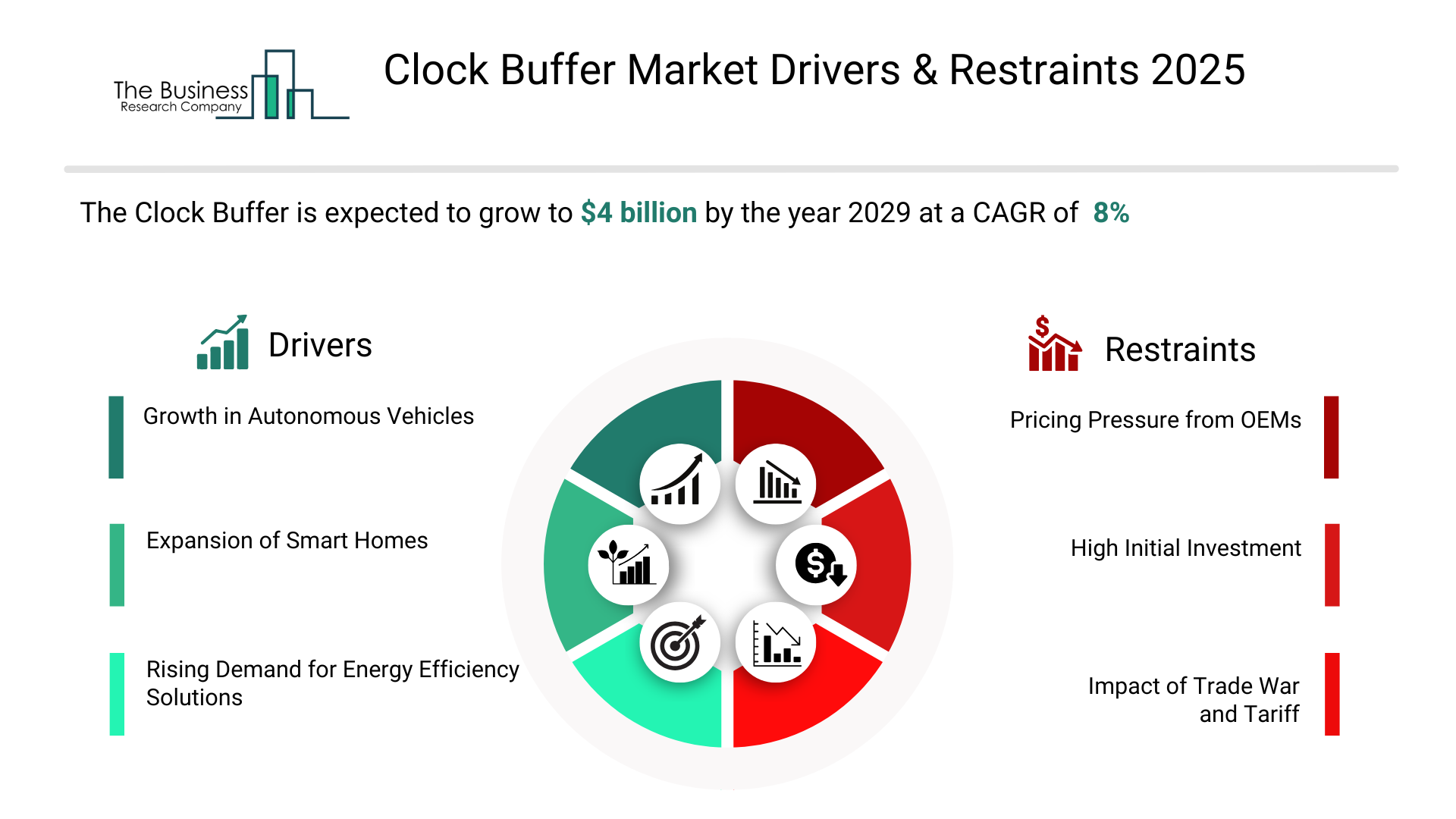
The expected CAGR for the clock buffer market leading up to 2029 is 8%.
What Will Be The Growth Driving Factors In The Global Clock Buffer Market In The Forecast Period?
The rapid growth of the global clock buffer market leading up to 2029 will be driven by the following key factors that are expected to reshape semiconductor design and timing signal management processes worldwide.
Growth In Autonomous Vehicles - The growth in autonomous vehicles will become a key driver of growth in the clock buffer market by 2029. Autonomous vehicles rely on multiple electronic control units (ECUs) and processors that require perfectly synchronized clock signals to process sensor data and execute commands accurately and without delay. Clock buffers play a critical role in distributing these signals while preserving timing integrity. With significantly higher electronic content compared to traditional vehicles, the demand for effective clock management—and consequently clock buffers—increases substantially. These buffers are essential for maintaining timing integrity and delivering jitter-free signals, which are critical for the safety and reliability of advanced features like real-time processing, machine learning, and vehicle-to-everything (V2X) communication. As a result, the growth in autonomous vehicles is anticipated to contributing to a 2.0% annual growth in the market.
Expansion of Smart Homes - The expansion of smart homes will emerge as a major factor driving the expansion of the clock buffer market by 2029. The rise of smart homes is increasing the number of connected devices, each relying on clock buffers to efficiently manage and distribute timing signals, thereby boosting market demand. These devices use wireless communication protocols that require precise synchronization to prevent interference and enable seamless data exchange, a function supported by clock buffers. Additionally, the emphasis on low-power, high-performance electronics in smart home products makes efficient clock signal management essential for optimizing energy use and extending battery life. Complex timing circuits in home automation hubs depend on clock buffers to deliver the accurate timing necessary for smooth operation across multiple interconnected devices. Consequently, the expansion of smart homes capabilities is projected to contributing to a 1.5% annual growth in the market.
Rising Demand for Energy Efficiency Solutions - The rising demand for energy efficiency solutions within digital manufacturing processes will serve as a key growth catalyst for the clock buffer market by 2029. The demand for energy-efficient clock buffers is rising as systems increasingly require components that minimize power consumption without compromising performance. In data centers, where energy use is substantial, low-power clock buffers play a critical role in enhancing power efficiency for server processors and networking hardware. Similarly, portable and battery-powered devices like smartphones, tablets, and laptops benefit from clock buffers that extend battery life by reducing energy usage in clock signal distribution. Additionally, the growth of IoT and smart devices, which often operate on limited power sources, further drives the need for advanced, energy-saving clock buffer technologies. Therefore, this rising demand for energy efficiency solutions across digital manufacturing operations is projected to supporting to a 1.2% annual growth in the market.
Favorable Government Initiatives - The favorable government initiatives will become a significant driver contributing to the growth of the clock buffer market by 2029. Many governments are implementing policies to strengthen their domestic semiconductor and electronics sectors through subsidies, tax incentives, and infrastructure investments. As clock buffers are critical components in chips and circuits, the growth in semiconductor manufacturing directly increases demand for these devices. Support for emerging technologies such as 5G, internet of things (IoT), artificial intelligence (AI), and data centers further propels the clock buffer market, given these applications rely on high-performance digital circuits with precise timing requirements. Additionally, government-funded research and development programs promote innovation in microelectronics and chip design, encouraging the creation of more efficient, low-power, and high-performance clock buffer solutions that expand market opportunities. Consequently, the favorable government initiatives strategies is projected to contributing to a 0.7% annual growth in the market.
Access the detailed Clock Buffer Market report here:
https://www.thebusinessresearchcompany.com/report/clock-buffer-global-market-report
What Are The Key Growth Opportunities In The Clock Buffer Market in 2029?
The most significant growth opportunities are anticipated in the differential clock buffer solutions market, the high-output (9–16 units) clock buffer market, and the clock buffer for IT and telecommunications market. Collectively, these segments are projected to contribute over $1 billion in market value by 2029, driven by rising demand for high-speed data transmission, increasing complexity of multi-channel digital systems, and the growing need for precise timing synchronization across advanced computing and telecom infrastructures. This surge reflects the accelerating adoption of high-performance clocking technologies that enable low-jitter signal distribution, enhanced system stability, and efficient frequency management, fueling transformative growth within the broader clock buffer industry.
The differential clock buffer solutions market is projected to grow by $631 million, the high-output (9–16 units) clock buffer market by $453 million, and the clock buffer for IT and telecommunications market by $397 million over the next five years from 2024 to 2029.
The Business Research Company (www.thebusinessresearchcompany.com) is a leading market intelligence firm renowned for its expertise in company, market, and consumer research. We have published over 17,500 reports across 27 industries and 60+ geographies. Our research is powered by 1,500,000 datasets, extensive secondary research, and exclusive insights from interviews with industry leaders.
We provide continuous and custom research services, offering a range of specialized packages tailored to your needs, including Market Entry Research Package, Competitor Tracking Package, Supplier & Distributor Package and much more
Disclaimer: Please note that the findings, conclusions and recommendations that TBRC Business Research Pvt Ltd delivers are based on information gathered in good faith from both primary and secondary sources, whose accuracy we are not always in a position to guarantee. As such TBRC Business Research Pvt Ltd can accept no liability whatever for actions taken based on any information that may subsequently prove to be incorrect. Analysis and findings included in TBRC reports and presentations are our estimates, opinions and are not intended as statements of fact or investment guidance.
The Business Research Company
Americas +1 310-496-7795
Europe +44 7882 955267
Asia & Others +44 7882 955267 & +91 8897263534
Email: info@tbrc.info"
Oliver Guirdham
The Business Research Company
+44 7882 955267
info@tbrc.info
Visit us on social media:
LinkedIn
Facebook
X
Legal Disclaimer:
EIN Presswire provides this news content "as is" without warranty of any kind. We do not accept any responsibility or liability for the accuracy, content, images, videos, licenses, completeness, legality, or reliability of the information contained in this article. If you have any complaints or copyright issues related to this article, kindly contact the author above.
